A short history of dinosaur hunting, from a bone people thought belonged to a giant, to a T. rex sold at auction.
1676
The first published picture of a dinosaur bone
The first published picture of a dinosaur bone appeared in 1676, in Robert Plot’s Natural History of Oxfordshire. He thought it might be from a giant human. [source]
1822–1825
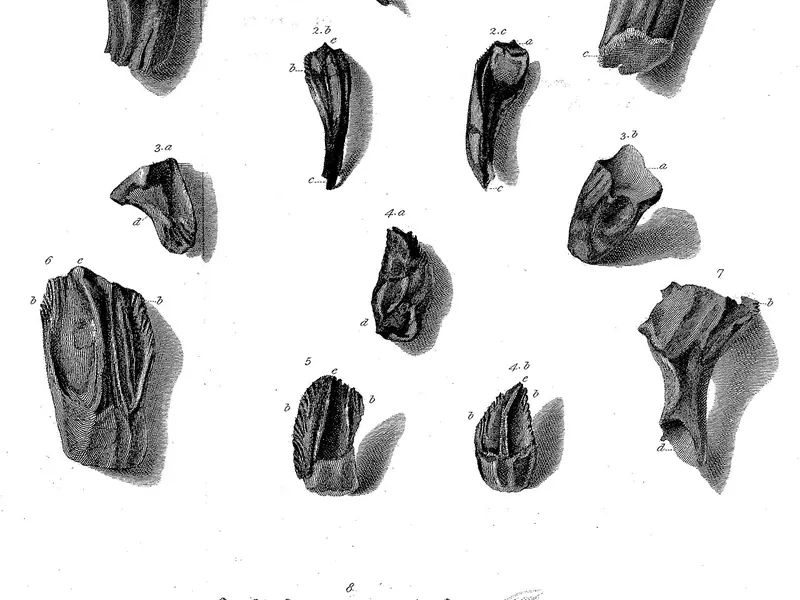
Iguanodon teeth in Sussex
There’s a popular story that Mary Ann Mantell found the first Iguanodon teeth in Sussex in 1822. Gideon Mantell himself said in 1851 that he had found them, and historians still argue about it. [source]
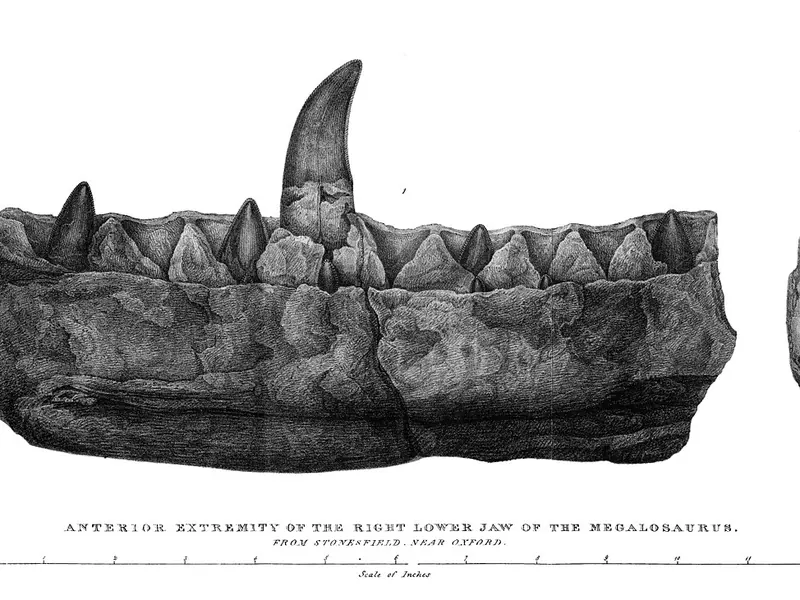
Iguanodon was named in 1825 by the English geologist Gideon Mantell. It was the second dinosaur ever formally named, after Megalosaurus. [source]
The word “dinosaur” means “terrible lizard”. Sir Richard Owen coined it in 1842. [source]
Owen based the group on three animals found in southern England: the meat-eating Megalosaurus, the plant-eating Iguanodon and the armoured Hylaeosaurus. [source]
1854
The Crystal Palace dinosaurs
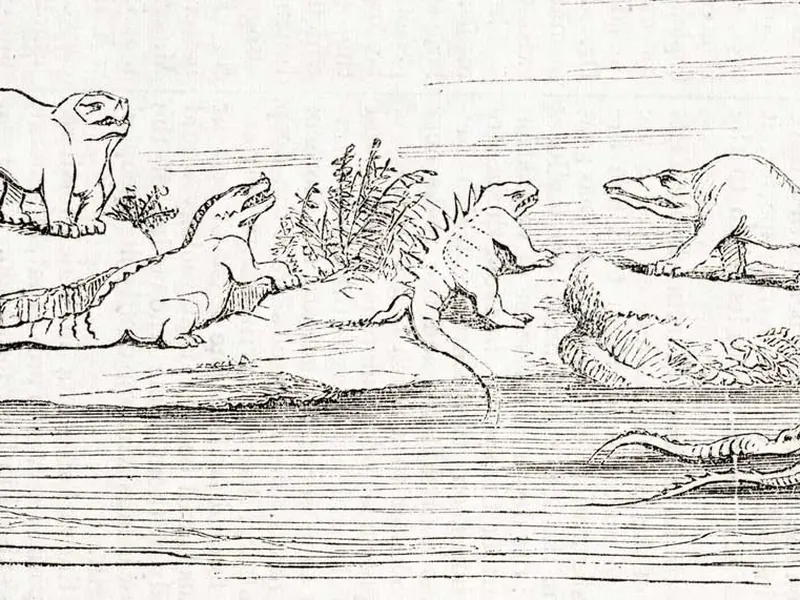
To launch them, Benjamin Waterhouse Hawkins held a dinner on New Year’s Eve 1853 inside the mould of one of the Iguanodon models. [source]
The Crystal Palace dinosaurs in south London were unveiled in 1854. They were the first dinosaur sculptures in the world. [source]
The Crystal Palace dinosaurs have been Grade I listed since 2007. [source]
Historic art: Benjamin Waterhouse Hawkins · Public domain · Wikimedia Commons
1859
The first documented dinosaur eggs
The first scientifically documented dinosaur eggs were found in southern France in 1859, by a priest, Jean-Jacques Pouech. They were mistaken for giant bird eggs. [source]
1861
Archaeopteryx, two years after Darwin
Archaeopteryx was named from a single feather in 1861. The first skeleton turned up the same year, two years after Darwin published On the Origin of Species. [source]
The first Archaeopteryx skeleton was sold to the Natural History Museum in London, where it still is. Richard Owen described it in 1863. [source]
1877 onwards
The Bone Wars
The Bone Wars, a bitter rivalry between Edward Drinker Cope and Othniel Charles Marsh, led to 142 new species of dinosaurs being discovered and described. [source]
Stegosaurus was described by Othniel Charles Marsh in 1877. At first he thought the bones came from an aquatic, turtle-like animal. [source]
Allosaurus was discovered during the Bone Wars, the feud between Marsh and Cope that set off a rush of fossil finds in the western US. [source]
1897
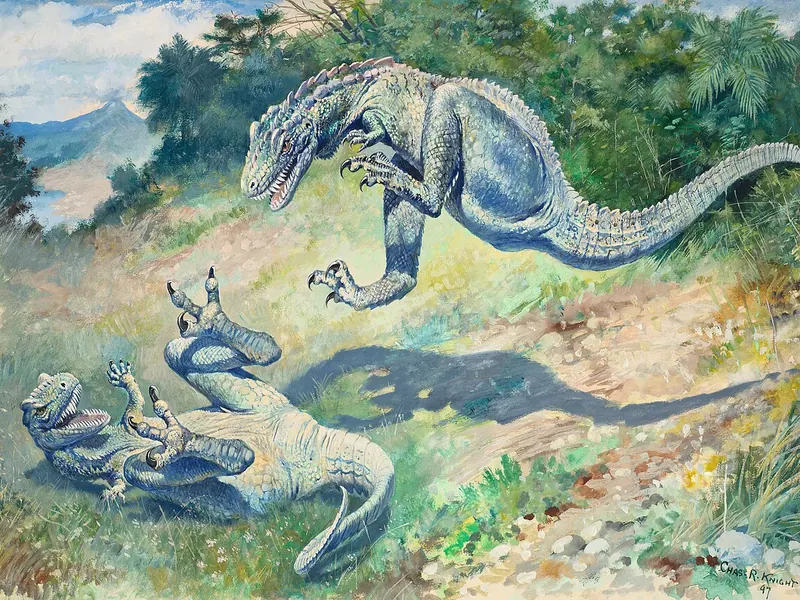
Leaping Laelaps
Charles R. Knight’s 1897 painting Leaping Laelaps was one of the few pictures before the 1960s to show dinosaurs as active, fast-moving animals. [source]
Laelaps was described by Edward Drinker Cope in 1866. The name had already been used for a mite, so the dinosaur is now Dryptosaurus. [source]
Knight was legally blind, partly from astigmatism, but kept painting. [source]
Historic art: Charles Robert Knight · Public domain · Wikimedia Commons
1899
Dippy the Diplodocus
The original Dippy skeleton was found on 4 July 1899, and was nicknamed the “star-spangled dinosaur”. [source]
A cast of “Dippy” the Diplodocus was on show at the Natural History Museum in London from 1905 until 2017. [source]
1909
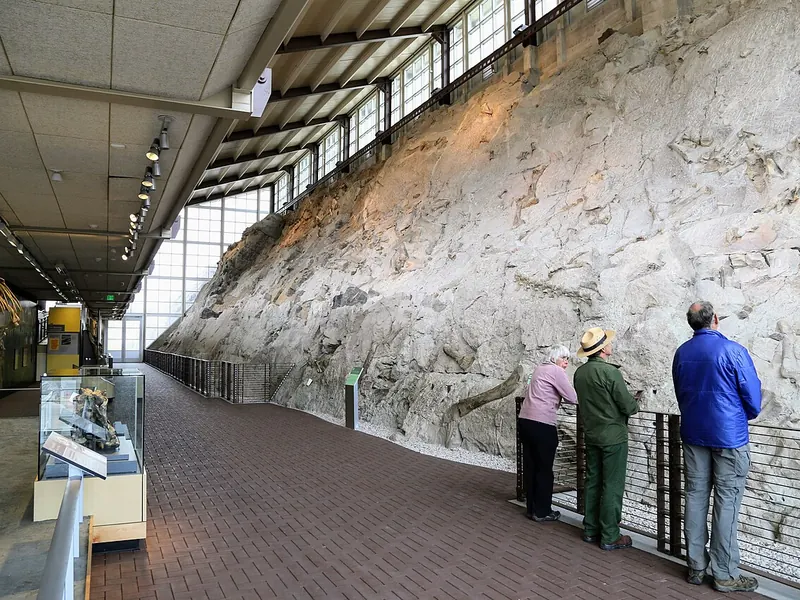
The Wall of Bones
Earl Douglass found the dinosaur beds of what became Dinosaur National Monument in 1909. It was declared a national monument in 1915. [source]
Its “Wall of Bones” is a steeply tilted rock face packed with fossils, inside the Dinosaur Quarry building. [source]
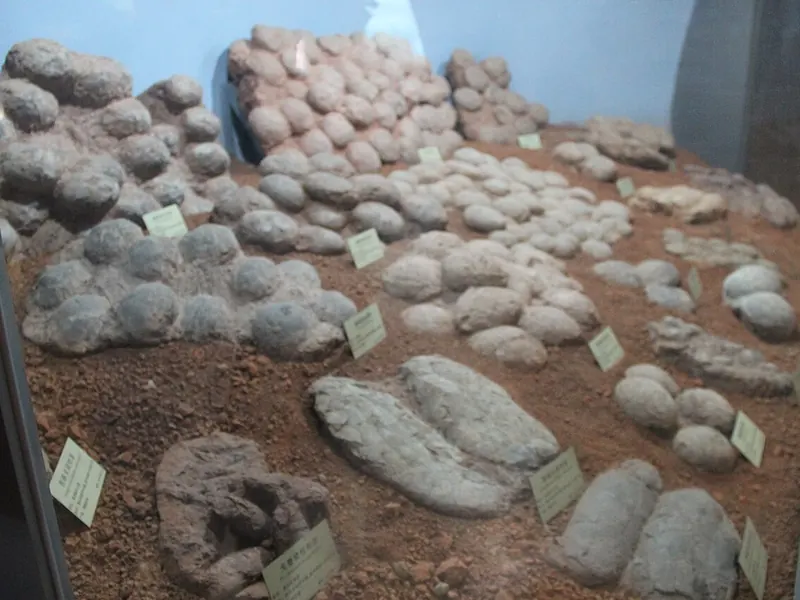
The first non-avian dinosaur eggs recognised as such by scientists were found in Mongolia in 1923, by an American Museum of Natural History team. [source]
Eggs found in Mongolia were first thought to belong to Protoceratops. They’re now known to be Oviraptor eggs. [source]
Sue, one of the most complete T. rex skeletons ever found, was discovered on 12 August 1990 by Sue Hendrickson, and is named after her. [source]
The Field Museum in Chicago bought Sue at auction on 4 October 1997, with a winning bid of US$7.6 million. [source]
A study of Sue’s bones showed she reached full size at 19 and died at 28. [source]
Before the dinosaurs had a name
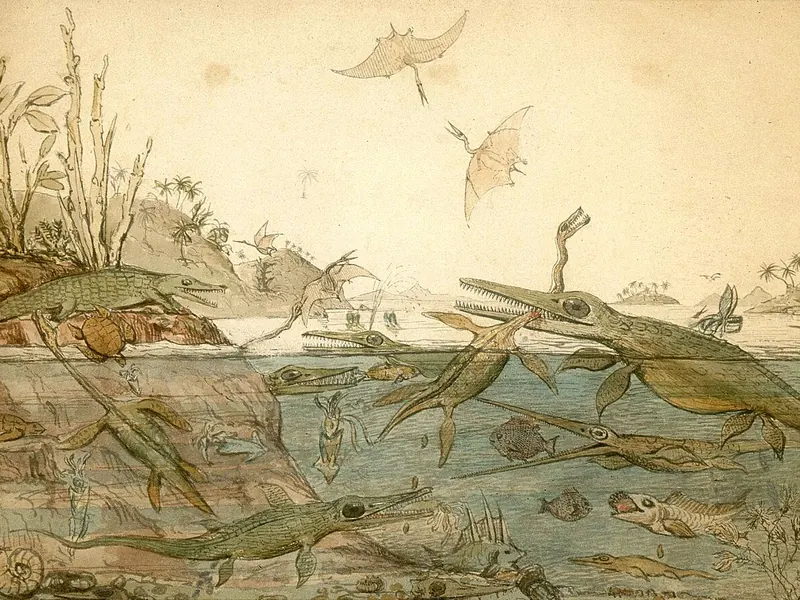
Mary Anning of Lyme Regis found the first correctly identified ichthyosaur skeleton when she was twelve, and the first two nearly complete plesiosaur skeletons. [source] In 2010 the Royal Society named Mary Anning one of the ten British women who have most influenced the history of science. [source]